
Editor’s note: This is an updated version of a blog post published on July 17, 2019
“At the end of the school year, I make sure that my resources are ready for next year”
– Helena (Ayales) Bryant
I look through my resources and make sure that they’re all still in good condition, that the sets are complete, and that they are still fit for purpose.
I am a stationary and resources enthusiast, they have to be functional but also attractive so that students will want to use and engage with them. My place value arrows are all in little bags and my place value counters are separated according to value. The same with my base ten resources. There’s nothing more frustrating than starting to teach a lesson and realising you don’t have the necessary concrete resources to hand.
As a maths coordinator, my next stop is the maths cupboard, also known as the dumping cupboard! In an ideal world, the maths cupboard is empty most of the time, because the resources are being actively used. Which in turn means that at the end of a term or year, everything is just dumped in there to be stored.
Having had a good sort, I’m in the right place to know what needs replacing or replenishing, as with all resources, I think children must eat counters, dice, and counting blocks. But you know what, it’s okay as long as they are being used and children are learning. I would much rather buy more dominoes because there were some missing then have unopened sets in pristine condition.
Helena (Ayales) Bryant, Assistant Head at St Peter and Paul Catholic Primary School, Merton.
“At the end of the school year, I give my class a broad experience of maths, plan our in-school transition, and organise training for new teachers”
– Tom Silver
As a Year 6 teacher, it’s easy to be overly focused on content related directly to the end-of-KS2 assessments. But this can lead to gaps in their understanding of the wider world and application of mathematics outside of their daily lessons.
Our final term in school is aimed at ensuring the children engage creatively in a topic that covers vital life skills. Therefore, alongside daily Maths — No Problem! sessions, my class will be working through a topic centered around fair trade. Through it, they will be given the opportunity to develop their use of problem-solving and entrepreneurial skills. I will expect them to be independent and creative with their use of mathematics.
The next thing we do at the end of the school year is to make sure our in-school transition is successful. It’s vital that our class teachers know their class well before September. We provide two afternoons for teachers to get to know their classes well. This is, of course, common practice in primary schools. However, we also make sure our most vulnerable pupils are given extra one-to-one sessions with their new teacher so that a strong relationship develops from an early stage.
Lastly, we organise training for new teachers. We are adamant that our teachers start teaching maths for mastery with confidence so we team up with an outstanding Teaching School Alliance who deliver three full days of training, making sure teachers who are new to our school feel well equipped to deliver the lessons.
Tom Silver, Mathematics Lead and Assistant Headteacher at SS John Fisher and Thomas More, Wythenshawe.
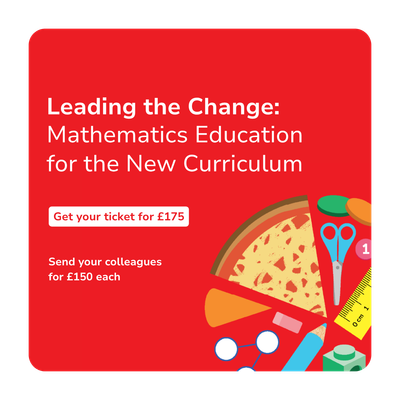
Community Event 2026
Join us on 14 October for a full day dedicated to transforming mathematics education!
With leading experts and classroom practitioners, we’ll explore the curriculum for 2028, share proven inclusion strategies and rediscover the joy of practical learning through pizza making.
“At the end of the school year, I organise an enterprise project, maths challenge days, and think about assessment and moderation of journals”
– Helen Hackett
After SATs, our Year 6 classes enjoy participating in an enterprise project. They organise the sales and learn about budgets, profit margins, etc. After the sales, each group decides which charity to send the profits to.
For Years 4 and 5, I organise maths challenge days like Harry Potter Day. The children spend a whole day using maths skills through Harry Potter themed activities. It’s a great chance to assess which maths skills the children have embedded as they apply them in a cross curricular way like this.
I also think about assessment. We ensure every year group carries out an end-of-year maths assessment, including an assessment of basic number fact fluency — including the Year 1 and Year 2 addition facts. We’ve found that the number one reason KS2 children struggle, is that they’ve left KS1 without basic number fact fluency, so if we can do something about this, it makes a huge difference.
We carry out journal moderation. Here, teachers share journals from selected children in their class with the teacher who is taking them on in September. They discuss which children are working within the age-expected range as well as those showing evidence of having mastered concepts more deeply.
It’s also this time of year that maths leaders prepare a report for school governors. It’s only when everything is recorded on paper, that we realise how far our staff and students have come. So, before we start planning for next year, we take time to sit back, relax and feel proud of what we’ve achieved.
Helen Hackett, Head of Maths at Parkfield Community School in Birmingham and Mastery Lead for the Central Region Maths Hubs.
Laura Connell
View ProfileBrowse By Topic
Your Teaching Practice
Boost your teaching confidence with the latest musings on pedagogy, classroom management, and teacher mental health.
View topic
→
Maths Mastery Stories
You’re part of a growing community. Get smart implementation advice and hear inspiring maths mastery stories from teachers just like you.
View topic
→
Teaching Tips
Learn practical maths teaching tips and strategies you can use in your classroom right away — from teachers who’ve been there.
View topic
→
Classroom Assessment
Identify where your learners are at and where to take them next with expert assessment advice from seasoned educators.
View topic
→
Your Learners
Help every learner succeed with strategies for managing behaviour, supporting mental health, and differentiating instruction for all attainment levels.
View topic
→
Teaching Maths for Mastery
Interested in Singapore maths, the CPA approach, bar modelling, or number bonds? Learn essential maths mastery theory and techniques here.
View topic
→
Deepen your mastery knowledge with our biweekly newsletter

By clicking “Accept All”, you agree to the storing of cookies on your device to enhance site navigation, analyze site usage and assist in our marketing efforts.