

2020 hit primary teachers hard. But there were bright spots too. Here’s what went well and why this year’s Assessment for Learning will contribute to planning for 2021.
The well-deserved holiday break is a chance to stop and recharge your batteries. It’s also an opportunity to reflect and think about the lessons you’ve learned in 2020. You may have finished one of the most unique first terms in recent memory, but remember, navigating exceptional challenges eventually brings growth.
You’ve learned lessons that not only support your formative assessment practice, but you’ve also gained insight into how Assessment for Learning contributes to planning.
How Assessment for Learning contributes to planning
In education news, it seemed that 2020 focused on the gaps that children developed during lockdown, school closures and disrupted learning. What was rarely heard was what was actually being learned or how Assessment for Learning could contribute to planning goals in 2021.
Schools never stopped. Schools never fully closed. We need to understand this and make sure the wider public does too.
Each school community worked to do the best for their children through unprecedented times. You often hear some of the most eminent intellectuals talk about childhood memories of learning by walking with relatives, having time to discuss ideas, and learning about what was around them.
While it’s true that aspects of children’s learning did suffer at times in 2020, it would be naive to think that a great deal of learning hasn’t taken place too. New learning that could contribute to your 2021 planning.
Find time to put on your Assessment for Learning hat and listen to the children in school, so they too can reflect on what they’ve learned in 2020.
How primary schools stepped up in 2020
We often say when teaching problem solving, you are teaching what to do when you don’t know what to do. This has never been demonstrated more clearly than during the pandemic. The resilience shown by children and their primary teachers should remind us what they are capable of and support our planning in 2021.
Plan for resilient learners
This generation of children have gone through something that no generation has had to before. In 2020, they lost their routine, and the dynamic between home and school shifted. For the best part of a year, children have been living in a world where people’s faces are always covered, yet they still smile back when the creases of an adult’s eyes show warmth.
I’ve heard this said many times when returning staff talk about their experience on residential trips, “I didn’t know that he could do that.”
This is an important reminder that struggle is a huge part of learning and when you are struggling, you need resilience in order to persevere.
This year, our learners have shown what they’re capable of. Understanding this will ensure children have room to discover concepts for themselves, grasp mathematical problems and tackle them in the same way they have for the majority of 2020.
Know that teaching staff will persevere
Of course the children’s resilience was supported by the huge planning efforts made by the staff of every school. Change is not always greeted with open arms and, at times, this is justified. But change on this scale has not been experienced by anyone currently involved in education.
The extraordinary effort that was made when the world turned upside down in March should be applauded, and should also remind you of the resilience of the staff.
There is no doubt that many teachers will need the upcoming break more than any holiday before. The fact that education continued from the first day of lockdown to the last day of the first term shows the level of commitment educators have for the good of the children in their schools.
And while there’s bound to be further disruption and hardship, remember that we can all greet change with pragmatism, strong analytical skills and a single-minded focus for the well-being of our school community.
Don't miss out
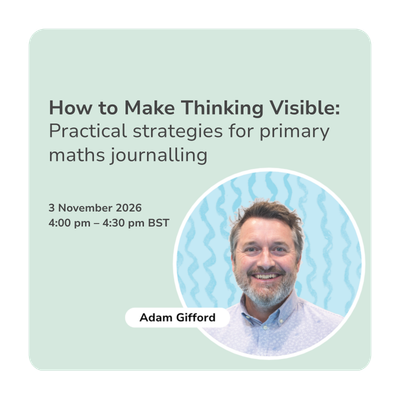
In this practical 30-minute webinar, explore how journalling can be developed from the Early Years through to Year 6.
What maths formative assessment was useful in 2020
The children in our schools have been in a huge range of situations this year. You’ve seen how they’ve coped with significant change and social disruption. This is all formative assessment. You are forming an idea about the whole child, and this is vital if you want them to learn to the best of their ability.
Children learning to cope with this level of adversity is not ideal, but one thing it will provide is a better formative assessment, and a clear understanding of what children do in order to cope. It’s likely you’ll have end of term assessment information available to you and you should be thinking about what those numbers tell us in the context of the whole child.
Formative assessment is a divisive word at times, but it doesn’t need to be. If you’re using what you know in order to support children’s learning, the children themselves are the ultimate benefactor.
Can you make 2021 even better than 2020?
Firstly, a proper break over the Christmas holiday is needed. That goes without saying.
But now that you know what the beginning of 2021 is likely to look like, you’re in a position to plan for it.
Your learners, staff and school community are at a level you probably haven’t had before, certainly not when dealing with this level of adversity. You can use this to your learners’ advantage. There may be situations that are impossible to fully prepare for, but it is possible to prepare for the idea of it.
Look to George Pólya’s problem-solving framework
For children, the problem-solving skills we often discuss may help. Influential thinker George Pólya talked about four stages of problem solving:
- Understand the problem
- Plan
- Carry out the plan
- Evaluate the first three points
While this is often discussed in mathematics, these steps can help you prepare for the unknown. Can we ask the children to evaluate how they found 2020 and what they would do differently?
When you teach these problem-solving skills through curriculum areas, you’re using the curriculum areas as a vehicle for skills that need to be built on over a lifetime.
Never have we been in a situation that requires problem-solving skills on this level. In 2020, it didn’t matter if you were a child, a teacher, a parent or someone in the wider community — we have all needed to solve problems.
We can learn from 2020, and while some aspects of 2021 may be out of our control, let’s use what we’ve learned to ensure 2021 brings us more good news than the previous year.
Interested in learning more?
See how Maths — No Problem! can support your practice through award-winning textbooks and workbooks, step-by-step teacher guides, and online CPD videos.
Request School Demo

Adam Gifford
View ProfileBrowse By Topic
Your Teaching Practice
Boost your teaching confidence with the latest musings on pedagogy, classroom management, and teacher mental health.
View topic
→
Maths Mastery Stories
You’re part of a growing community. Get smart implementation advice and hear inspiring maths mastery stories from teachers just like you.
View topic
→
Teaching Tips
Learn practical maths teaching tips and strategies you can use in your classroom right away — from teachers who’ve been there.
View topic
→
Classroom Assessment
Identify where your learners are at and where to take them next with expert assessment advice from seasoned educators.
View topic
→
Your Learners
Help every learner succeed with strategies for managing behaviour, supporting mental health, and differentiating instruction for all attainment levels.
View topic
→
Teaching Maths for Mastery
Interested in Singapore maths, the CPA approach, bar modelling, or number bonds? Learn essential maths mastery theory and techniques here.
View topic
→
Deepen your mastery knowledge with our biweekly newsletter

By clicking “Accept All”, you agree to the storing of cookies on your device to enhance site navigation, analyze site usage and assist in our marketing efforts.