
Editor's Note: This is an updated version of a blog post published on 22 June 2022
If you are visiting the museum, the beach or a new country, you can use small moments to encourage mathematical thinking.
Summer is on its way! Although it’s a crucial time for your child to unwind and relax after the busy school year — it is also a fantastic opportunity to weave everyday maths into their daily life. You can keep your kids learning through subtle, low-key activities which will help them retain all the knowledge they have worked so hard to gain during the school year.
Using board games
Maths isn’t just about doing calculations; there is also a great deal of reasoning and problem solving involved. Simple board games you’d play as a family can include maths learning for children. Encourage a discussion of game strategy with your child. Being able to articulate your thoughts is a key skill that’s regularly suggested as a teaching point in maths journalling.
The questions that you discuss could be as simple as:
- How would making a different move have affected your score?
- What is your strategy?
- Can you write down your plan including each step and your intentions?
In fact, explaining methods and writing them down in words is a very effective way for children to reflect on mathematical concepts, spot mistakes and challenge themselves. If you find your child isn’t keen on writing ideas down — suggest drawing them instead!
Playing fun games like multiplication bingo and number countdown can also keep your child’s mind maths-friendly and provide a little more one-to-one support.
Day trips
Another subtle yet meaningful way to keep those minds engaged is to plan a day trip somewhere exciting! If you are visiting a museum, the beach or a new country, you can use small moments to encourage mathematical thinking.
If you’re planning a trip to the beach, for example, you could ask how much petrol you’ll need and how much it costs per litre to calculate the total cost of travel.
For a museum, you might need to catch a train. You can check train timetables and plan when you would need to leave to arrive at a certain time.
For a trip abroad, you could look at time zone differences or flight durations. Even activities such as understanding the rate of exchange in a foreign country would be a great exercise.
Give your child some responsibility so that they will be challenged into deepening their understanding of mathematical concepts. Keep them in charge of telling you when it’s time to leave, and ask them to calculate how many more minutes are left before your departure. Ask them to inform you when your flight will land, or how much money is left in the kitty for ice cream!
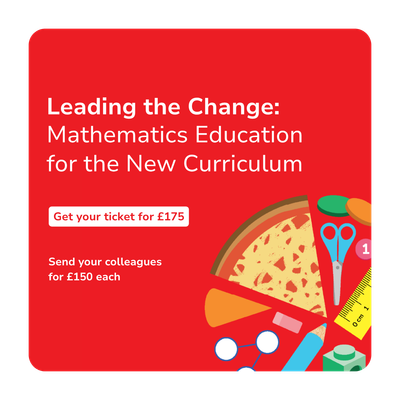
Community Event 2026
Join us on 14 October for a full day dedicated to transforming mathematics education!
With leading experts and classroom practitioners, we’ll explore the curriculum for 2028, share proven inclusion strategies and rediscover the joy of practical learning through pizza making.
Outdoor activities
Outdoor activities are prime during the summer months, and simple resources like paint and chalk can be used for everyday learning.
If your child is slightly younger, use chalk and paint to practise number formation and ordering. If they are a bit older, you can practise mixed operations and various methods they can use.
An activity for all is drawing out shapes, finding their properties and comparing them with other shapes. If you want to take it even further, get out your ruler and ask your child to measure the shapes they have drawn. You can reinforce perimeter and area by asking what they need to know to work it out. It doesn’t have to be a full-blown maths lesson; simple questions and resources for a few minutes can consolidate learning.
Cooking
Cooking is a fantastic way to introduce various mathematical concepts as well as teach your child useful day-to-day skills. For example, introducing measurement and conversion.
Try asking simple questions like:
- How many grams are there in a kilogram?
- How much do I need to take away to follow the recipe?
- If I wanted to double the batch, how would my ingredients change?
You could also create a budget before visiting the grocery store. Then you could ask questions like:
- If I buy 3 bags of flour that cost 70p each, how much money will I have left over?
- Will that work within the amount I have to buy the additional items?
Good old-fashioned sums
Lastly, sitting down and doing traditional sums never hurt anyone! Although nothing hardcore, a few minutes a day or a week can help retain knowledge that might otherwise be lost. You could even skip through one of your child’s old workbooks and find some questions to work out together. If you’re feeling reflective, you could get those old maths journals out — reread reflections and review pictures or methods — then create posters or quick notes to organise the information for better retention.
The summertime doesn’t need to be a break from learning. Children can still work their brains and have fun. Maths-friendly activities like board games or cooking can help keep your child’s mind active while they enjoy their summer holiday and all that comes with it. Plus, spotting maths in the ‘real world’ might even help your child better understand the importance of becoming a confident mathematician in the classroom!
Fatemah Moledina-Damani
View ProfileBrowse By Topic
Your Teaching Practice
Boost your teaching confidence with the latest musings on pedagogy, classroom management, and teacher mental health.
View topic
→
Maths Mastery Stories
You’re part of a growing community. Get smart implementation advice and hear inspiring maths mastery stories from teachers just like you.
View topic
→
Teaching Tips
Learn practical maths teaching tips and strategies you can use in your classroom right away — from teachers who’ve been there.
View topic
→
Classroom Assessment
Identify where your learners are at and where to take them next with expert assessment advice from seasoned educators.
View topic
→
Your Learners
Help every learner succeed with strategies for managing behaviour, supporting mental health, and differentiating instruction for all attainment levels.
View topic
→
Teaching Maths for Mastery
Interested in Singapore maths, the CPA approach, bar modelling, or number bonds? Learn essential maths mastery theory and techniques here.
View topic
→
Deepen your mastery knowledge with our biweekly newsletter

By clicking “Accept All”, you agree to the storing of cookies on your device to enhance site navigation, analyze site usage and assist in our marketing efforts.