
In mathematics, where concepts build strictly upon one another, a single unformed concept early on can stall a child’s progress years down the road.
It’s a challenge every Key Stage 2 teacher knows all too well: how do you identify learning gaps early, before they widen into something harder to bridge?
When the learning gaps feel more like canyons, the instinct can be to panic, abandon the current curriculum, and start drilling lower-year worksheets. But this often isolates SEND learners further, disconnecting them from the rich mathematical experiences of their peers.
What is a learning gap?
Essentially, a learning gap is the divide between what a pupil has actually learned and what they were expected to learn by a specific point in their education. Think of it as a missing brick in a structural wall. In mathematics, where concepts build strictly upon one another, a single unformed concept early on can stall a child’s progress years down the road. Rather than a reflection of a child's potential, these gaps are simply administrative milestones that were missed along the way due to pacing, absences, or unsupported learning needs.
Example of a learning gap
Kirsty, one of the educators at our recent webinar, put it perfectly: she’s currently teaching a Year 6 class of SEND pupils who have significant gaps in their learning, stretching all the way back to Year 2.
“Today we were recapping equivalent fractions,” Kirsty shared, “and some were struggling with knowing that double 2 is 4.”
Instead of pulling children out of the Year 6 classroom context, we need to look at how we can close learning gaps systematically using a spiral curriculum and purposeful, targeted intervention.
How to identify learning gaps early to move forward
The beauty of a spiral curriculum is that mathematical concepts are never taught as isolated events; they are revisited, deepened, and expanded over time. When a pupil struggles with a complex concept like equivalent fractions, the root of the problem usually lies a few spirals down.
Using the Maths — No Problem! Spiral Curriculum support documents, teachers can visually trace a concept backward to find its exact foundation and isolate specific examples of learning gaps.
- Identify the prerequisite small steps: For a student struggling with fractions, the issue might not be the concept of a fraction itself, but rather the underlying concept of "equal grouping" or basic multiplication structures taught years prior.
- Connect misconceptions to prior units: Once you locate where the understanding broke down (e.g., Year 2 handling of equal groups or simple doubling), you can plan targeted interventions that explicitly connect that early concept to the current Year 6 task.
Don't miss out
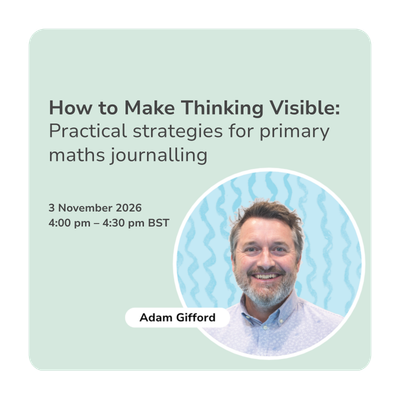
In this practical 30-minute webinar, explore how journalling can be developed from the Early Years through to Year 6.
Top tips to bridge learning gaps
1. Don't put away the manipulatives
One of the most common mistakes in Key Stage 2 is assuming that concrete materials — like cubes, counters, and place value discs — are just for younger children.
For SEND pupils with significant learning gaps, maintaining access to manipulatives beyond Key Stage 1 isn’t just a comfort measure; it’s a cognitive necessity. When introducing a new or challenging idea, the time spent in the concrete phase of the Concrete-Pictorial-Abstract (CPA) approach may need to be significantly longer to embed the representation safely.
If a Year 6 pupil doesn't instantly recall that double 2 is 4, don't just state the abstract fact. Let them build it. Use the exact same task structure as the rest of the class, but simply step back one representational step (from abstract or pictorial back to concrete) to provide conceptual clarity and actively work on bridging the learning gap.
2. Leveraging the textbook and board for consistency
When working memory is overloaded by gaps in basic numeracy, visual consistency is your best friend. SEND learners can lose valuable cognitive energy just trying to figure out where to look.
To reduce this demand during whole-class teaching and small-group interventions:
- Mirror the textbook structure: Use a visualiser or your interactive board to display the exact layout of the textbook page. Keeping the "board-to-book" transition seamless means less cognitive energy is spent on navigation and more on mathematics.
- Use the power of variation: Highlight the incremental changes in the textbook examples. By prompting pupils to look at two side-by-side problems and ask, “What’s the same? What’s different?”, you help them notice patterns and invariance, allowing them to make mathematical generalisations even if their arithmetic recall is slow.
By mapping interventions to the spiral curriculum and leaning heavily on the CPA approach, we can meet SEND learners exactly where they are — and close any learning gaps — without lowering our expectations of what they can achieve.
See it in action: Discover how the Maths — No Problem! approach keeps every learner on track by watching this classroom video featuring Craig Robinson.
Browse By Topic
Your Teaching Practice
Boost your teaching confidence with the latest musings on pedagogy, classroom management, and teacher mental health.
View topic
→
Maths Mastery Stories
You’re part of a growing community. Get smart implementation advice and hear inspiring maths mastery stories from teachers just like you.
View topic
→
Teaching Tips
Learn practical maths teaching tips and strategies you can use in your classroom right away — from teachers who’ve been there.
View topic
→
Classroom Assessment
Identify where your learners are at and where to take them next with expert assessment advice from seasoned educators.
View topic
→
Your Learners
Help every learner succeed with strategies for managing behaviour, supporting mental health, and differentiating instruction for all attainment levels.
View topic
→
Teaching Maths for Mastery
Interested in Singapore maths, the CPA approach, bar modelling, or number bonds? Learn essential maths mastery theory and techniques here.
View topic
→
Deepen your mastery knowledge with our biweekly newsletter

By clicking “Accept All”, you agree to the storing of cookies on your device to enhance site navigation, analyze site usage and assist in our marketing efforts.