Adaptive Maths: How to plot a way in and a way forward in maths, for all pupils


Author's Note: Originally published in Teach Primary magazine (October 2025).
Walk into any maths classroom and you’ll see it: pupils starting from different points. Some race ahead confidently, others stall and wait for help, while many hover in between.
For years, ‘traditional differentiation’ — splitting the class into ability groups with separate worksheets and outcomes — was the go‑to solution. Whilst designed to meet diverse needs, it can be hard to sustain, adds to workload, and may leave pupils labelled by fixed ability.
Whole‑class differentiation offers an inclusive alternative. It starts with one rich problem everyone can access, then layers in talk, visuals, scaffolds, and challenges so all pupils have a way in and a way forward. The result is a shared journey where confidence grows, misconceptions are addressed early, and no one feels “less than” in maths.
Exploration before explanation
When pupils explore before being shown a method, maths becomes theirs to investigate, not the teacher’s to hand down. Prompts like “What do you notice?” invite multiple approaches — counting, drawing, modelling, or moving to equations. This builds resilience, curiosity, and validates the children’s ideas.
In this phase, pupils can test strategies, make mistakes, and own their thinking. As the teacher, you can lend them a listening ear, help them connect threads, and guide the class towards an efficient method. For example, if the objective is to understand that fractions represent equal parts, children might begin by exploring objects: can they divide them fairly? Try giving them first-hand experience by folding paper shapes or sharing food items. When you then introduce the formal method, it connects with what pupils have already discovered. Creating these small opportunities for exploration can enrich pupils’ understanding and strengthen long-term learning.
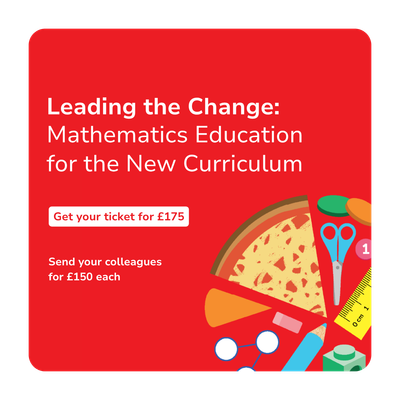
Community Event 2026
Join us on 14 October for a full day dedicated to transforming mathematics education!
With leading experts and classroom practitioners, we’ll explore the curriculum for 2028, share proven inclusion strategies and rediscover the joy of practical learning through pizza making.
Talk before textbook
Talking is a powerful whole‑class tool. Explaining thinking aloud and hearing others’ strategies expands problem‑solving skills, and sentence stems like “I noticed…” or “I solved it by…” help all pupils to join in. In maths especially, giving children a chance to try out subject-specific vocabulary can help them connect abstract concepts with practical strategies.
Why not try grouping the class into pairs or threes (making sure to mix abilities) and asking each child to take it in turns performing an action with manipulatives, while their teammates describe what they’re doing. For example, one child could line up eight cubes in front of them, then split the cubes in half, putting four on each side of the table. Their teammates could narrate ‘8 divided by 2 is four’. You can let children decide on their own strategies, or provide cards or prompts on the board to give them some ideas. Afterwards, discuss as a class what vocabulary the children used and heard, and whether any of the problems were particularly tricky to describe, and why. Small groups with mixed abilities will give all children a chance at exploring problems, without the pressure of solo work or whole-class scrutiny.
Depth before speed
While routine maths problems can build fluency and provide useful practice, for many pupils, long lists of questions can feel overwhelming — especially for SEND learners. An alternative is to focus on five or six rich problems that highlight patterns and prompt questions like “What’s the same?” and “What’s different?” This creates space for depth, talk, and connection-making. For example, if the children need to practice subtraction skills, you can present pairs of questions that are minimally different in presentation (such as 6 − 4 = X and 2 = 6 − X). Ask pupils to identify whether the questions are asking the same thing, and why. This can help pupils identify problems from different perspectives, and understand the essential mathematical principle that there is often more than one correct solution. This exercise also allows for simple differentiation, depending on the difficulty of the problem and the extent of difference between questions.
Slowing the pace often accelerates long‑term progress, too; pupils understand, rather than recall mechanically.
Approaches such as these will help your children to explore the kind of maths skills that will benefit them throughout their education and into the real world, as well as introducing them to mathematical thinking. When pupils see themselves as mathematicians, confidence grows — and that’s what underpins long‑term success.

Craig Parkinson
View ProfileBrowse By Topic
Your Teaching Practice
Boost your teaching confidence with the latest musings on pedagogy, classroom management, and teacher mental health.
View topic
→
Maths Mastery Stories
You’re part of a growing community. Get smart implementation advice and hear inspiring maths mastery stories from teachers just like you.
View topic
→
Teaching Tips
Learn practical maths teaching tips and strategies you can use in your classroom right away — from teachers who’ve been there.
View topic
→
Classroom Assessment
Identify where your learners are at and where to take them next with expert assessment advice from seasoned educators.
View topic
→
Your Learners
Help every learner succeed with strategies for managing behaviour, supporting mental health, and differentiating instruction for all attainment levels.
View topic
→
Teaching Maths for Mastery
Interested in Singapore maths, the CPA approach, bar modelling, or number bonds? Learn essential maths mastery theory and techniques here.
View topic
→
Deepen your mastery knowledge with our biweekly newsletter

By clicking “Accept All”, you agree to the storing of cookies on your device to enhance site navigation, analyze site usage and assist in our marketing efforts.