
According to extensive research syntheses by the Education Endowment Foundation (EEF), metacognitive and self-regulation strategies consistently deliver high impact for very low cost — adding an average of +7 months of additional progress over the course of an academic year.
If you have ever watched a pupil stare at a challenging problem, take a deep breath, and say, "I tried strategy A, but it didn't work — let me try drawing a diagram instead," you have seen metacognition in action.
Understanding metacognition in education is one of the single most powerful levers for transforming passive learners into active, self-directed thinkers. In this guide, we will break down what metacognition and education look like in practice, why research places it at the top of high-impact teaching strategies, and how you can embed these tools in your everyday classroom routine.
What is metacognition in education?
Metacognition in education is often defined as "thinking about thinking" — the process where a learner becomes aware of and reflects on their own cognitive processes. In a classroom setting, it means pupils consciously plan how to tackle a task, monitor their comprehension as they work and evaluate their success and strategy afterwards.
Rather than simply asking “What is the answer?” a metacognitive learner asks "How am I thinking about this problem, and is my approach working?" By shifting the focus from final answers to the process of learning, metacognition helps pupils develop self-regulated learning habits that stick with them across all subjects.
Example of metacognition in a maths classroom
To see how metacognition works in practice, picture a Year 5 pupil tackling a multi-step word problem: "A bakery bakes 240 muffins. They pack them into boxes of 6, selling each box for £4. How much money do they make?"
A pupil using metacognitive strategies naturally moves through three distinct phases:
- Planning: Before diving into calculation, the pupil pauses to analyse the task. They ask themselves: "What is this question asking me to find? I need to know the total money made, but first, I need to know the number of boxes. I'll sketch a bar model to visualise the two steps."
- Monitoring: As they work through 240 muffins divided by 6 muffins per box = 40 boxes, they pause to check their progress: "Does 40 boxes make sense? Yes, 40 times 6 = 240. Now I need to multiply by £4. Am I still on track to answer the original question?"
- Evaluating: Once they reach £160, they step back to assess their strategy: "Did my bar model help me avoid missing a step? Yes. Next time I see a multi-step problem like this, starting with a visual model is definitely the way to go."
Why is metacognition in education so important?
Integrating metacognition into daily learning yields benefits that reach far beyond getting a single question right on a test.
When pupils learn how to evaluate their own thinking, key transformations happen:
- It builds independent, self-regulated learners: Pupils stop relying on the teacher for immediate reassurance at the first sign of difficulty.
- It strengthens problem-solving skills: Instead of guessing randomly when stuck, pupils learn to pause, pivot and choose an alternative strategy.
- It fosters resilience and growth mindsets: Mistakes cease to feel like failures; instead, they become valuable data points for evaluating what strategy to try next.
- It promotes deep understanding: Metacognition pushes pupils past simple rote memorisation, encouraging them to link new mathematical concepts to prior knowledge.
What the research says:
According to extensive research syntheses by the Education Endowment Foundation (EEF), metacognitive and self-regulation strategies consistently deliver high impact for very low cost — adding an average of +7 months of additional progress over the course of an academic year.
Don't miss out
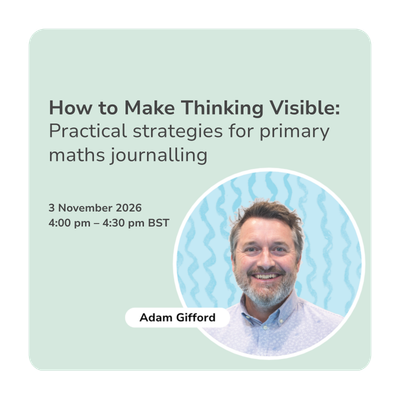
In this practical 30-minute webinar, explore how journalling can be developed from the Early Years through to Year 6.
How metacognition can support pupils with SEND
For pupils with Special Educational Needs and Disabilities (SEND), executive function tasks — such as keeping track of multi-step directions, organizing thoughts, or managing working memory — can quickly lead to cognitive overload. Metacognitive approaches offer a structured framework that makes implicit thinking explicit.
While there is no single, universal approach, metacognition supports pupils with SEND by:
- Reducing cognitive overload: Breaking complex tasks into clear, repeatable routines (Plan -> Monitor -> Evaluate) reduces the burden on working memory.
- Providing visual scaffolding: Using sentence stems, visual checklists and graphic organisers gives pupils concrete anchors to guide their internal dialogue.
- Empowering self-regulation: Giving pupils explicit tools to track their own understanding helps build autonomy, reducing the frustration and anxiety that often accompany challenging work.
Practical strategies to teach metacognition
Teaching metacognition isn't about adding a brand-new subject to an already packed timetable. Instead, it’s about making cognitive processes visible during everyday lessons. Here are four practical ways to embed metacognitive habits into your primary maths classroom:
1. Explore learning and thinking journals
Encourage pupils to keep a short reflection log at the end of a math lesson or unit. Prompts don't need to be long or complex — simple questions like the following train pupils to evaluate their learning process systematically:
- "What was the trickiest part of today's lesson?"
- "Which strategy helped you out when you were stuck?"
- "What would you do differently next time?"
2. Model your own thinking out loud
One of the most effective ways to teach metacognition is through explicit teacher modelling. When solving a problem on the board, speak your internal dialogue out loud — including the missteps!
Say things like: "Hmm, I’m looking at this array and I'm not quite sure where to start. Let me pause and rethink... if I break this down into smaller chunks, will that make it easier?" Demonstrating how an expert navigates uncertainty normalises the struggle for pupils.
3. Teach the language of metacognition
Pupils need a vocabulary to articulate their internal thought processes. Explicitly teach and display prompts around the classroom, such as:
- "My first step was..."
- "I chose this strategy because..."
- "I noticed an error in my work when..."
- "An alternative way to solve this might be..."
Providing these sentence openers gives pupils the tools they need to discuss their reasoning with confidence during paired and group work.
4. Encourage a mindset of mathematical reflection
Shift classroom culture so that arriving at the correct numerical answer isn't the sole goal. Once a problem is solved, ask pupils to reflect on the path they took. Prompt pairs to compare their approaches: "Did you both solve it the same way? Whose method was more efficient, and why?" This helps pupils realise that mathematics is a flexible, creative discipline with multiple valid paths to a solution.
How Maths — No Problem! supports metacognition
At Maths — No Problem! metacognitive thinking is built directly into the DNA of every lesson. Rather than relying on passive instruction, the primary series uses an anchor-task approach that invites pupils to explore, question and discuss mathematical concepts before formal methods are introduced.
By combining the Concrete-Pictorial-Abstract (CPA) approach with structured peer discussion and journal writing, pupils are naturally prompted to visualise problem structures, articulate their strategies and evaluate their understanding at every stage of the lesson.
Chris Fournier
View ProfileBrowse By Topic
Your Teaching Practice
Boost your teaching confidence with the latest musings on pedagogy, classroom management, and teacher mental health.
View topic
→
Maths Mastery Stories
You’re part of a growing community. Get smart implementation advice and hear inspiring maths mastery stories from teachers just like you.
View topic
→
Teaching Tips
Learn practical maths teaching tips and strategies you can use in your classroom right away — from teachers who’ve been there.
View topic
→
Classroom Assessment
Identify where your learners are at and where to take them next with expert assessment advice from seasoned educators.
View topic
→
Your Learners
Help every learner succeed with strategies for managing behaviour, supporting mental health, and differentiating instruction for all attainment levels.
View topic
→
Teaching Maths for Mastery
Interested in Singapore maths, the CPA approach, bar modelling, or number bonds? Learn essential maths mastery theory and techniques here.
View topic
→
Deepen your mastery knowledge with our biweekly newsletter

By clicking “Accept All”, you agree to the storing of cookies on your device to enhance site navigation, analyze site usage and assist in our marketing efforts.