
For educators who have long championed a mastery approach, reading the Curriculum and Assessment Review feels less like a radical departure and more like a long-overdue validation.
The education landscape in England is shifting. With the publication of the final Curriculum and Assessment Review report, schools and school leaders are looking ahead to structural changes designed to shape the future of learning for children aged 5 to 19. For primary maths leads, the DfE-commissioned curriculum and assessment review signals a decisive move away from rote learning and toward deeper conceptual understanding, number fluency and strategic curriculum sequencing. Whether you are planning your professional development cycles or evaluating your current math schemes, understanding these foundational shifts now is the key to a seamless transition over the coming years.
What is the curriculum and assessment review
The Curriculum and Assessment Review is an independent review of what children and young people aged 5–19 learn and how they are assessed in England. Commissioned by the government in July 2024 and chaired by Professor Becky Francis CBE, the final report was published in November 2025.
The review’s findings were informed by comprehensive research, statistical evidence, polling data and over 7,000 public responses. You can read the full context directly in the government's Curriculum and Assessment Review final report.
What stands out for primary maths
The review takes a clear, evidence-led stance on mathematics education, emphasizing that solid structural foundations are essential before tackling complex problem-solving.
1. Number fluency in Key Stage 1
The review believes there should be a stronger focus on developing fluency in the fundamentals of number at Key Stage 1 and that space should be made within the number domain to prioritise this. Evidence suggests that understanding in number is one of the most critical elements of Maths for preparation for later life.
We therefore recommend placing greater emphasis on fluency in number in Key Stage 1, with a particular focus on developing fluency in number bonds and addition and subtraction in a range of contexts. This enhanced focus should be integrated alongside other content taught at this stage, such as shape and measurement.
Given the foundational importance of number fluency, it's essential that knowledge gaps are diagnosed as early as possible — nationally, only 61% of disadvantaged pupils met the expected standard in KS2 maths last year, against 80% of their peers, a gap the review's push for early diagnosis is aimed at closing before it widens further. While the review does not recommend reinstating statutory tests at the end of Key Stage 1, it encourages all schools to use the non-statutory Maths test.
2. Multiplicative reasoning in Key Stage 2
At Key Stage 2, the priority shifts toward ensuring all pupils build competence in multiplicative reasoning and problem-solving.
We believe the priority at Key Stage 2 should be ensuring all pupils build competence in multiplicative reasoning and problem-solving. Multiplicative reasoning includes secure understanding of multiplication and division scaling, repeated addition, arrays, and whole number rates. Appropriate stretch and challenge for all pupils, including the highest attainers, should come primarily through reasoning and problem solving.
3. Resequencing the primary maths curriculum
To enable a deeper focus on core concepts without overloading teachers or students, the review highlights the importance of spacing content more evenly across key stages.
To enable this increased focus on the fundamentals of number in Key Stage 1, and to support learning in later years, we believe there is a strong case for resequencing the Maths curriculum whilst protecting curriculum time or content. This would involve spacing content more evenly and appropriately across key stages, supporting pupils and students to develop fluency and allow for non-routine problem solving.
Don't miss out
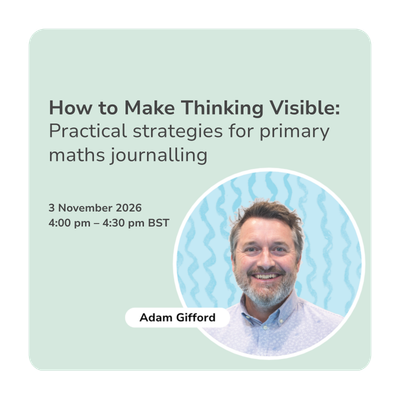
In this practical 30-minute webinar, explore how journalling can be developed from the Early Years through to Year 6.
What the curriculum review gets right about primary maths
For educators who have long championed a mastery approach, reading the Curriculum and Assessment Review feels less like a radical departure and more like a long-overdue validation. For years, the debate in primary mathematics has often swung between procedural speed and conceptual depth. The review makes it refreshingly clear: true mathematical proficiency requires both, but fluency must come first.
By shining a spotlight on the foundational importance of number fluency in Key Stage 1 and multiplicative reasoning in Key Stage 2, the report targets the exact friction points that teachers face in the classroom every day. Too often, children stumble in later years not because they lack effort, but because gaps in early number bonds and additive reasoning were left unaddressed.
Equally encouraging is the review's emphasis on resequencing rather than overloading. The recommendation to space content more evenly across key stages acknowledges a vital classroom truth: rushing through a crowded curriculum prevents deep learning. When content is thoughtfully sequenced, pupils are given the cognitive space to master concepts thoroughly and tackle non-routine problem-solving with confidence.
These principles aren't just theoretical recommendations at Maths — No Problem! — they are the bedrock of our approach. Mastery isn't about teaching harder concepts earlier; it's about building a robust, connected foundation where every child can succeed. The review gets it right by prioritising depth over breadth, proving that the future of primary maths relies on coherent, carefully structured learning pathways.
Experts behind the new national curriculum
Dozens of curriculum drafters have been chosen to help the government revise the national curriculum following the review. Among them is Lynne McClure OBE, Chair of the Education Workstream at the Academy for the Mathematical Sciences, who has previously shared her expertise with Maths — No Problem!
Preparing for the 2028 curriculum isn’t just about adapting to new policy, it's about seizing the opportunity to deepen pupils’ mathematical understanding and foster true engagement in every classroom,” said Lynne McClure. “I am delighted to be keynoting this year's Maths — No Problem! Community Event and leading these discussions with educators who are eager to shape the future of maths teaching.
Schools don't need to wait for new changes in the national curriculum
With further guidance scheduled to arrive for schools in Autumn 2026 ahead of the new curriculum going live in September 2028, it is easy to feel the pressure of an impending overhaul. However, schools don't need to wait.
The core principles highlighted in the review — number fluency, mastering topics deeply, and clear, spaced sequencing — are already built directly into the Maths — No Problem! product offering.
Frequently asked questions
When will the new national curriculum be introduced in schools? The reformed curriculum is due to be introduced in schools from September 2028. The Department for Education has confirmed further guidance for schools will follow in Autumn 2026.
Will Key Stage 1 SATs be reintroduced? No. The Curriculum and Assessment Review specifically recommends against reintroducing statutory national tests at the end of Key Stage 1. It does, however, encourage all schools to use the non-statutory Maths test to diagnose gaps in number fluency as early as possible.
What does the curriculum and assessment review recommend for primary maths? The review recommends a stronger focus on number fluency in Key Stage 1, multiplicative reasoning in Key Stage 2, and resequencing content across key stages so pupils can master topics more deeply rather than encountering repetition in later years.
Who led the curriculum and assessment review? The review was chaired by Professor Becky Francis CBE. It was commissioned by the government in July 2024 and the final report was published on 5 November 2025.
Did the government accept the review's recommendations? The government accepted the majority of the review's recommendations. It has confirmed the reformed National Curriculum will start in September 2028, alongside related changes such as removing EBacc performance measures.
Ready to ensure your classroom is equipped for the future of maths? Get in touch with our team today to discover how our mastery resources can support your school's journey.
Chris Fournier
View ProfileBrowse By Topic
Your Teaching Practice
Boost your teaching confidence with the latest musings on pedagogy, classroom management, and teacher mental health.
View topic
→
Maths Mastery Stories
You’re part of a growing community. Get smart implementation advice and hear inspiring maths mastery stories from teachers just like you.
View topic
→
Teaching Tips
Learn practical maths teaching tips and strategies you can use in your classroom right away — from teachers who’ve been there.
View topic
→
Classroom Assessment
Identify where your learners are at and where to take them next with expert assessment advice from seasoned educators.
View topic
→
Your Learners
Help every learner succeed with strategies for managing behaviour, supporting mental health, and differentiating instruction for all attainment levels.
View topic
→
Teaching Maths for Mastery
Interested in Singapore maths, the CPA approach, bar modelling, or number bonds? Learn essential maths mastery theory and techniques here.
View topic
→
Deepen your mastery knowledge with our biweekly newsletter

By clicking “Accept All”, you agree to the storing of cookies on your device to enhance site navigation, analyze site usage and assist in our marketing efforts.