"This is a 10 year journey:" what a decade of mastery teaching actually looks like

Half the kids used to go off and be completely unsuccessful. And today, 85 or 90% of our kids are passing these examinations in the top group of the country. It's a really really different trajectory for those kids.
– Dr Jeremy Hannay, Executive Principal
Ask a school that has got maths right how it happened, and you rarely get the answer you were hoping for.
When Neil Le Feuvre, headteacher at St Bridget's CE Primary in the Wirral, near Liverpool in northwest England, is asked about his school's maths, he interrupts the question before it finishes.
"Whoa, whoa, whoa. This is a 10 year journey. Don't think all of this happened day one."
There is no launch moment in that answer, no single intervention, no term in which everything changed. But it is the most accurate description of mastery teaching available, and it is echoed almost word for word by the schools that have been at it longest.
Sarah Matthews, head of school at Stanton St Quintin in Wiltshire, in southwest England, which adopted the approach in 2015, puts the same point more bluntly. "Did our maths results go up straight away? No, but you need time to implement it. You have to be in it for the long haul."
Two schools, some 300 kilometres apart, arriving at the same conclusion. So what does that decade actually consist of?
Most of it is invisible
The first thing to understand is that very little of a ten-year journey is visible from outside the school.
St Bridget's did not spend a decade rolling out a scheme. It spent the decade building the conditions that let a scheme work. Le Feuvre told his governors at the outset that the change would take five years, and then made it the single standing priority for that entire period: "So for five years, maths mastery was the number one thing on our school development plan."
Five years. One priority. That is the part that rarely makes it into a case study, because it is not a strategy so much as a refusal to be distracted.
What it bought was a change in the adults before any change in the children. Rosie Ross, the school's assistant head and maths lead, describes the moment the approach made sense to her as "the light bulb moment of my teaching career" — followed immediately by the "absolute realisation that I have really got to know my stuff."
That sequence is the whole thing in miniature. The teacher's understanding deepens first. Everything else is downstream of it.
The person who changes first
Ross Deans teaches Year 6 at Muscliff Primary in Bournemouth on England’s south coast, where he has worked for 13 years and leads maths. Before teaching, he was a conservationist. He is also, by his own account, someone who spent most of his life avoiding the subject he now leads.
"Maths for me was an area of anxiety. It was something I wasn't very confident in," he says. "It was something that repelled me as quite a creative person when I was young."
This is more common than schools tend to admit. A significant number of primary teachers carry their own difficult history with maths into the classroom and are expected to teach it every day regardless. What changed for Deans was not a resource. It was coming to understand the mathematics well enough that it stopped looking like a set of procedures to survive and started looking like something with a structure he could see.
"There's a really different relationship with maths as a subject now," he says — and he is as clear about what the school is not chasing: "As a school there's a pressure to have good performance, but we're not going into this to create robots."
Muscliff adopted the approach in 2017. Results climbed steadily, with 2019 the school's strongest year at that point; the pandemic interrupted the run, and the school has since pulled further ahead of national figures.
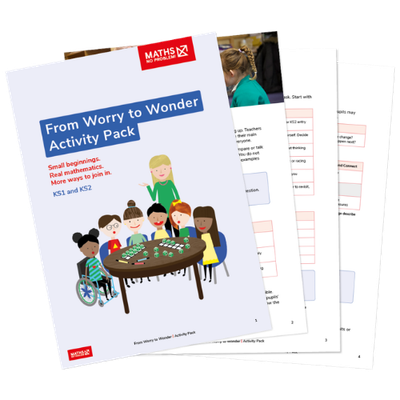
From Worry to Wonder
A new Maths — No Problem! classroom activity pack!
Make accessible opportunities for all children no matter their starting point.
What it produces
Eventually the numbers do have to show up, and the place to look is where the intake makes them hardest to achieve.
At Three Bridges Primary in Ealing, west London, more than 60% of pupils do not speak English as a first language and around a third are eligible for free school meals. In its most recent results, 90% of pupils reached the expected standard in maths and 52% reached greater depth — roughly double the national figure. Greater Depth is England’s measure for working beyond the expected standard. In the 2023 Year 4 multiplication tables check, 69% of pupils scored full marks, against 29% nationally.
Executive principal Dr Jeremy Hannay, who arrived in 2012, is direct about the before and after. "Half the kids used to go off and be completely unsuccessful," he says. "And today, 85 or 90% of our kids are passing these examinations in the top group of the country. It's a really really different trajectory for those kids."
The change he describes as most significant, though, is not a number. "There are lots of kids who see themselves now as problem-solvers and mathematicians." And on the phrase every primary teacher has heard from a child: "That old 'I can't do maths, I'm not great at maths' — I don't think anybody thinks that's cool anymore."
Not only a UK story
The question schools ask most often is whether this travels.
Mesaieed International School in an industrial city south of Doha, Qatar began its shift to mastery around five years ago. Roughly 550 pupils in Years 1 to 6 now follow the programme, 95% of them bilingual or multilingual learners. Head of Primary Lewis Hutchinson reports attainment well above the English national average — but, as at Muscliff, points first at the staff. "Our teaching staff have less maths anxiety than before," he says. "They are feeling more confident to ask the right questions, direct students in the right way."
The school has since moved from adopting the approach to supporting others. Its Teacher Research Group has become an informal regional hub, and at least two other international schools have taken up the programme as a result.
That progression is the most telling detail in any of these stories. A school that has implemented a programme can describe it. A school that can teach another school how to do it has understood it.
Where this goes next
Maths — No Problem! is early in its work with Canadian schools, and it would be premature to claim outcomes here.
But the Canadian connection in this story is older than the Canadian schools. Jeremy Hannay, who leads one of the strongest primary maths results in England, was born in Canada and started his teaching career in Ontario. The approach that reshaped Three Bridges was not foreign to him when he found it; he recognised what it was doing and spent a decade building a school around it.
That is roughly the position Canadian schools are in now — at the start of something whose results are measured in years rather than terms, built on the same foundation as St Bridget's, Muscliff, Three Bridges and Mesaieed: a coherent curriculum, teachers given the time and support to understand it deeply, and the patience to let that understanding take hold.
If a decade in classrooms teaches anything, it is to be honest with schools at the outset about what they are taking on. Any programme promising transformation by Christmas should be treated with suspicion.
It is a 10 year journey. The schools that know that going in are the ones that get there
Chris Fournier
View ProfileBrowse By Topic
Classroom Assessment
Identify where your learners are at and where to take them next with expert assessment advice from seasoned educators.
View topic
→
Maths Mastery Stories
You’re part of a growing community. Get smart implementation advice and hear inspiring maths mastery stories from teachers just like you.
View topic
→
Teaching Maths for Mastery
Interested in Singapore maths, the CPA approach, bar modelling, or number bonds? Learn essential maths mastery theory and techniques here.
View topic
→
Teaching Tips
Learn practical maths teaching tips and strategies you can use in your classroom right away — from teachers who’ve been there.
View topic
→
Your Learners
Help every learner succeed with strategies for managing behaviour, supporting mental health, and differentiating instruction for all attainment levels.
View topic
→
Your Teaching Practice
Boost your teaching confidence with the latest musings on pedagogy, classroom management, and teacher mental health.
View topic
→
Deepen your mastery knowledge with our biweekly newsletter

By clicking “Accept All”, you agree to the storing of cookies on your device to enhance site navigation, analyze site usage and assist in our marketing efforts.