

If sustained attention, curiosity and delayed gratification are becoming harder to come by, those qualities become more important for schools to nurture, not less.
A delegate asked me a question recently during a Maths — No Problem! training session:
“How can we best present our lessons to the TikTok generation?”
My instinctive response was: don’t.
Or, more accurately, don’t assume that because children are increasingly accustomed to short, fast-moving pieces of content, our lessons should become shorter and faster too.
If anything, perhaps school needs to provide something different.
Attention is becoming more valuable
There are good reasons for teachers to be concerned about attention.
The latest OECD PISA results show continuing declines in reading and mathematics across OECD countries, while more than a quarter of students report being distracted by digital devices in most or every science lesson.
Research into off-task smartphone and social-media use is still developing, so we should be careful about making sweeping claims. But a recent systematic review found that most studies showed a negative relationship between off-task use and academic achievement, with problematic use particularly consistently associated with poorer outcomes.
So perhaps the question is not simply: How do we capture children’s attention?
It might be: How do we help them develop it?
Don’t confuse engagement with entertainment
One response to shorter attention spans is to make learning more stimulating: quicker activities, more frequent changes and a succession of hooks designed to keep pupils interested.
There is clearly a place for making learning appealing.
But every additional hook also takes time away from the thing we ultimately want pupils to do: think.
And there is a danger that, without meaning to, we teach children that if something does not reward their attention immediately, something else will soon arrive.
Mathematics can offer a different experience.
A carefully chosen problem can invite pupils to stay with something.
To notice.
To look for a pattern.
To connect it to something they already know.
To try an idea, discover that it does not quite work and try something else.
In other words, to think harder for longer.
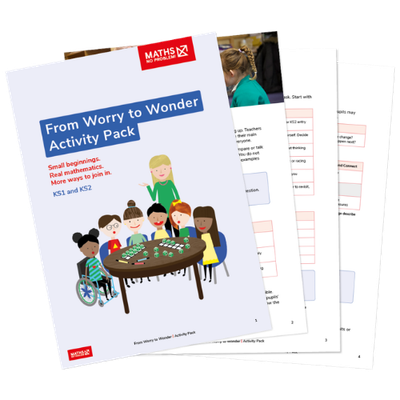
From Worry to Wonder
A new Maths — No Problem! classroom activity pack!
Make accessible opportunities for all children no matter their starting point.
Curiosity can become a habit
We sometimes talk about curiosity as though children either possess it or they don’t.
But curiosity can also be developed through the routines we establish.
In the Explore phase of a Maths — No Problem! lesson, the teacher does not immediately explain how to solve the problem. Instead, pupils are given time and structure to investigate it.
Simple prompts can help:
What do you notice?
What do you already know?
What is the same? What is different?
Can you represent it another way?
What might happen if…?
These questions do more than move a maths lesson forward. Repeated over time, they give pupils a repertoire for what to do when the answer is not immediately obvious.
Getting stuck is part of learning
This matters because getting stuck is not necessarily evidence that learning has gone wrong.
Sometimes it is where the interesting learning begins.
The EEF’s evidence on metacognition and self-regulation is particularly relevant here. It suggests that pupils benefit when teachers explicitly help them to plan, monitor and evaluate their own thinking, and that these strategies are most effective when embedded within normal curriculum learning rather than taught as separate “thinking skills”.
That might mean resisting the temptation to rescue pupils too quickly.
Not abandoning them to struggle, but giving just enough support for them to remain in the problem.
“What have you tried?”
“What could you use?”
“Which part do you understand?”
“What might you try next?”
That is where perseverance becomes something more useful than simply telling children to “keep going”.
Something worth slowing down for
We should, of course, meet pupils where they are. But that does not mean leaving them there.
If sustained attention, curiosity and delayed gratification are becoming harder to come by, those qualities become more important for schools to nurture, not less.
The answer to the TikTok generation may not be to make mathematics compete with TikTok.
It may be to offer something TikTok rarely does: a problem worth staying with long enough to solve.
That is one of the reasons why the Explore phase of the Maths — No Problem! lesson matters. It gives pupils repeated opportunities not simply to learn mathematics, but to learn how to attend, question, connect, persist and think for themselves.
And those are habits likely to matter long after the lesson has finished.

Craig Parkinson
View ProfileBrowse By Topic
Classroom Assessment
Identify where your learners are at and where to take them next with expert assessment advice from seasoned educators.
View topic
→
Maths Mastery Stories
You’re part of a growing community. Get smart implementation advice and hear inspiring maths mastery stories from teachers just like you.
View topic
→
Teaching Maths for Mastery
Interested in Singapore maths, the CPA approach, bar modelling, or number bonds? Learn essential maths mastery theory and techniques here.
View topic
→
Teaching Tips
Learn practical maths teaching tips and strategies you can use in your classroom right away — from teachers who’ve been there.
View topic
→
Your Learners
Help every learner succeed with strategies for managing behaviour, supporting mental health, and differentiating instruction for all attainment levels.
View topic
→
Your Teaching Practice
Boost your teaching confidence with the latest musings on pedagogy, classroom management, and teacher mental health.
View topic
→
Deepen your mastery knowledge with our biweekly newsletter

By clicking “Accept All”, you agree to the storing of cookies on your device to enhance site navigation, analyze site usage and assist in our marketing efforts.